Vertigo

Vertigo
Vertigo

Friday, February 28, 2014

AMERICAN HUSTLE -the Art of Seduction and Survival

Suggested by actual events of the Abscam sting in the 1970s, the FBI plans to setup and arrest corrupt politicians. How they get the officials and the professional con artists that help the sting operation are the basis of a nostalgic film.  As directed and co-written by David O. Russell (Silver Linings Playbook, The Fighter), American Hustle is an acting clinic highlighting a convoluted tale of men and women who are looking for a big score.   


In 1978, ambitious FBI agent Richie DiMaso (Bradley Cooper), forces con man Irving Rosenfeld (Christian Bale) and his mistress, Sydney Prosser (Amy Adams), to help arrange a con on white collar crime, specifically targeting corrupt politicians.  Richie wants to make a name for himself, and he is immediately attracted to Sydney and has designs on her beyond the con.  Starting with a local, beloved mayor, Carmine Polito (Jeremy Renner), high level political figures are drawn in, and there is the possible organized crime connection. Further, Irving’s wife, Rosalyn (Jennifer Lawrence), threatens to derail the sting.  As Richie’s grand plan comes together, things get more complicated and risky, and Irving and Sydney must rely on their skills to survive. 


These are very well etched characters.  Each has something to gain, and each has an angle to exploit, whether it’s Richie’s dreams of a big bust or Rosalyn’s threats to expose the operation.  Kindred souls and survivors, Irving and Sydney have mastered the art of deception and manipulation.  You feel a degree of sympathy for Irving despite his criminal past and his marital discord.  Not only does he love his women, but he tries to save a friend from jail.  Irving turns out to be someone to root for.  In fact the world is not black and white especially when an FBI agent breaks the rules and gets involved with one of the principals.  Carmine is the noble, elected official who truly believes in doing good for his community.  Just who are the good guys and bad guys? Just who is conning who? 


Memorable scenes include a catty confrontation in a women’s restroom, the faceoff between Richie and his beleaguered boss (played to great effect by Louis C. K.), and an incredibly tense meeting with a head mobster (Robert DeNiro in a lethal cameo). 

Acting is superior throughout as expected in a Russell ensemble with the principals at the top of their game.  Bale transforms his physical appearance as an overweight, balding schlep (a far cry from The Dark Knight’s Batman).  A sultry Adams (Doubt, Her) has a great time playing a kindred con artist with a British accent.  Cooper (Limitless, The Hangover) has a ball as the gung ho agent with a 1970s perm who will step over his boss to get his time in the sun.  Lawrence (The Hunger Games, Winter’s Bone) excels as the wife who exhibits a bold brashness in public which delights her onlookers but risks blowing the sting.

There is liberal use of 1970’s pop songs which blend with the costumes and hair styles seamlessly.  The camera work is fluid and is reminiscent of early Martin Scorsese films. There is a very carefree attitude in the film’s look and feel which is consistent with this loose, uninhibited decade. 

A slice of the seventies with freewheeling hustlers and loose morals, at its core, American Hustle is a love story centering on Irving, an imperfect con artist and the women in his life.  The film is essentially a con within a con and keeps you guessing until the end.  Although the film’s narrative is not as tight as it could have been, Russell has sacrificed a tiny bit of substance for style.  Do admire this film for the many scenes that pit flawed characters against each other.  Acting does not get much better than this.

***1/2 of ****stars

GRAVITY Soars
Some films (Castaway, 127 Hours) have a simple premise, a basic tale of survival, devoid of large casts and complicated plotlines.  Co-written with his son Jonás Cuarón, director and co-writer Alfonso Cuarón (Harry Potter and the Prisoner of Azkaban, Y Tu Mamá También) has combined state of the art technology and remarkable acting by Sandra Bullock in a spectacular, tension-filled adventure, Gravity.
 
American astronauts Ryan Stone (Sandra Bullock) and Matt Kowalski (George Clooney), work on repairs to the Hubble space telescope as news of a nearby Russian satellite explosion is reported.  The quiet serenity is suddenly displaced by hurtling debris that decimates the repair mission and causes great damage to the telescope and more.  Caught up in a life threatening disaster and stranded in space without any hope of rescue, the two must improvise and utilize survival skills to survive under impossible circumstances.  As hope fades and oxygen running low, the astronauts must make difficult choices to make it home alive. 


Caurón successfully conveys the emptiness and vastness of space and how isolated it can be.  What is remarkable is that this film could not have been made so convincingly until now because of recent technological developments.  Even director James Cameron (Avatar), who was consulted early on, championed the film’s ambitions for space realism that was years in the making.  A ground breaking achievement in visual effects, not since Stanley Kubrick’s 2001: A Space Odyssey or Apollo 13 has a film so realistically depicted space travel.  Even the realistic use of sound or lack of it enhances the authenticity.  Great care and research obviously went into the production. 
The film boldly starts with a continuous panning shot for thirteen minutes with nary a cut.  When was the last time a major Hollywood film did that?  There are some remarkable shots in space like the one instance where Bullock is in a womb-like position which acts as a metaphor of life.  Gravity deserves to be seen in 3D (perhaps the best 3D film since Avatar) which opens up the magnitude of the visual effects.  When did any 3D film show a person’s tears?  This one does.  The realism and emptiness of space will be hard to match so convincingly in future films. 
Cuarón establishes a basic premise and creates a major conflict while continually upping the ante of impending danger.  The suspense is palpable as we feel as if we are there with Bullock and must figure a way to first get out of harm’s way and then to go home to earth.  The one film this reminds you of is Marooned. 
This is Bullock’s (The Blind Side) show all the way as you feel her fears amid every threat; she is in virtually every shot.  We learn to understand her feelings and get a glimpse into her past about her regrets in life.  Paradoxically, space becomes a place to escape her past or prove to be her death.  One major theme for her character is learning to let go whether it be a painful past memory or letting go of something in the here and now.  It’s about finding a reason to live and finding a deeply personal redemption under the most trying circumstances. 
Clooney lends strong support as her veteran colleague and voice of reason who offers instructions and calm amid tragedy.  You will never guess who voices mission control, but here’s a hint-see Apollo 13.
 
Sure, despite convenient coincidences that facilitate some plot points and a couple situations that are a bit hard to believe, Bullock sells it with her conviction and desperation; you buy into the situation regardless even if it may be hallucination or a dream.
What should be noteworthy is the fact that Gravity is rated PG in an era when PG13 and R rated major releases dominate the marketplace.  And it runs a lean 90 minutes.  How such a simple tale of survival and hope becomes not only totally engaging but such a compelling, landmark work of cinema is the lasting legacy of Gravity.
**** of **** stars

 
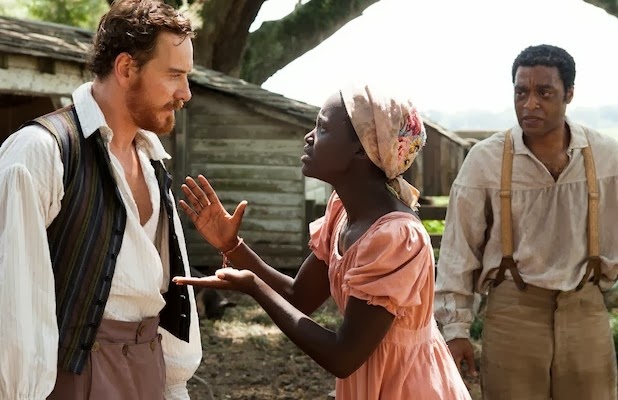
12 YEARS A SLAVE for the Ages

Director Steve McQueen (no relation to the actor) has made a name for his personal, bold themes (Shame) and has come of age with his latest, most affecting film, 12 Years a Slave, adapted by John Ridley from the novel by Solomon Northrop.  Perhaps no major studio film has portrayed slavery in America so honestly and directly. 

 
Solomon Northrop (Chiwetel Ejiofor) is a free man in New York in 1841 with a wife and two children.  He is educated and blessed with a talent for playing the violin.  A tempting offer of work leads him to Washington D.C. where two white men trick him into being mistaken for a slave.  Helpless and unable to communicate with his family or anyone who can help him, Solomon is pulled into the world of torture and servitude as a slave to be auctioned as a commodity in the South.  Northrop is witness to inhumanity by white slave owners as families are torn apart.  He is sold from one plantation to another and finds one owner, Edwin Epps (Michael Fassbender, a standout), who is not only strong willed but cruel and immoral.  Time goes by, and he always maintains a sense of dignity and hope while exhibiting compassion for his brethren.  Northrop’s desperate attempts to escape or get a letter to his family need the sympathetic ear of a good Samaritan for his salvation.
 
Imagine being held against your will and performing menial, backbreaking work at the behest of cruel masters who strike out with deadly violence at the drop of a hat.  Now imagine that as an educated slave, he dares not reveal his intelligence lest he be executed.  Silence means survival.   Rebellion is met with severe punishment and death.  All this goes on year after year with little or no hope. 

That it took this long in cinema history to depict this stain of human intolerance is sobering especially in the post-Roots generation.  McQueen depicts the horrors of oppression and outright sadism while getting the details such as the frightened reactions of slaves to mere sounds.  He also has a firm sense of time and place with striking visuals.  Cinematography is excellent, and the period recreation is authentically convincing with historic set design and costumes as well as the flavor of music.  The film is similar to the lean narrative of Clint Eastwood’s recent films without the emotional pathos of Steven Spielberg. 

Ejiofor (Salt) has the best role of his career, and aside from the always impressive Fassbender (Prometheus), the surprise performance has to be Lupita Nyong’o as perhaps the most tragic of slaves.  Benedict Cumberbatch (perhaps the busiest actor currently) has an effective role of a sympathetic slave owner.  In an interesting bit role, Saturday Night Live’s Taran Killam shows a brief glimpse of dramatic potential.  There are several name actors who take supporting or bit roles including Paul Giamatti, Paul Dano, and Alfre Woodard.  Brad Pitt has a brief but significant moment that is a turning point in the story.  He had a significant role as producer in bringing the book to the screen, and it shows just how shrewd he was to take a chance on a story that needed to be told. 

It’s a very sobering journey in American history that is harrowing and painful, and by the time the powerful ending arrives, you may find yourself not only thoroughly drained, but more appreciative of the life of one person (whose postscript is also noteworthy).  It’s a difficult subject matter handled by McQueen with compassion and unflinching realism.  A moving chronicle of a family torn apart amid historical injustice, 12 Years a Slave is about the indomitable human spirit and its ultimate triumph amid intolerable adversity. 

**** of **** stars

Thursday, February 27, 2014

CAPTAIN PHILLIPS and His Captors

Based on the real life story and book by Captain Richard Phillips, Captain Phillips is an authentic recreation of the events leading up to the hijacking of an American freighter ship on the high seas by modern day Somali pirates in 2009.  Directed by Paul Greengrass (United 93, The Bourne Ultimatum), the film is a non-stop edge of your seat entertainment that puts you in the midst of a seemingly hopeless situation.  Tom Hanks and a talented supporting cast bring the participants to life in one of the year’s best films. 


Phillips is a responsible commander of a freighter with a small crew.  As he boards his ship and readies to embark at sea, a group of Somali men prepares to search for nearby ships to board and hold hostage for money.  As the freighter nears the Somali waters, the pirates give chase and the race is on as Phillips follows a series of procedures to elude and repel the invaders.  When the pirates board and take control of the bridge by force, the dynamic has shifted to a hostage situation. As the Somali, who are smart and cautious, search the ship for other crew members, it becomes a tense game of cat and mouse.  Led by Muse (Barkhad Abdi), the pirates want money even as US military forces come to the rescue.  A tense standoff leads Phillips and his captors to the freighter’s life boat and a race against time to save the brave captain. 


Phillips and his crew take creative steps to make this hijacking as difficult as possible.  They even follow a protocol for securing the ship from boarders by running drills and taking extra precautions.  Phillips himself proves resourceful even when alone with his captors by making innocent suggestions that have ulterior motives and meaning. 
The scene where the pirates take over the bridge is well shot and has a real time feel.  Nobody shoots docudramas better than Greengrass with his rapid edits and handheld cameras.  He conveys a sense of progressively worsening desperation and hopelessness.  Henry Jackman’s score matches the intensity of the film. 

Like the concluding mission in Zero Dark Thirty, the final sequence here is meticulously detailed and ratchets the suspense to an unbearable level even though most people know how these events transpired.  The play is the thing, and Greengrass executes the finale like a true, military SEAL operation complete with preparations and tactics.  The climax is a brilliantly edited moment of split second timing, patience, and decisive action. It affects the audience on a visceral level where so much is at risk
Hanks (Saving Mr. Banks, Philadelphia) is completely convincing as Phillips.  Abdi is authentic and menacing as Muse, all the more impressive since he was a total amateur when cast in the role. You even feel a bit of sympathy for Muse because he comes from a place of poverty where there are few options in life, and you come to realize that he is a person under extreme pressure from his bosses on the mainland.   In fact, utilizing mostly unknowns aside from Hanks, works to the film’s realism.  The other Somali men are each given a chance to shine and have unique personas which makes what happens to them a shared experience. 

You also wonder how Phillips’ wife and family are reacting to the crisis but you never see them despite Catherine Keener’s brief role as his wife at the beginning.  That could have raised the stakes a bit more emotionally.
By the film’s stunning resolution, there is an emotional release in Phillips that the audience shares.  It is in these last several minutes that Hanks draws you into his heartbreaking trauma.  It is here that he excels in an emotional performance in an emotional film, where a brave man said and did the right things under extreme duress.  

***1/2 of **** stars (add ½* for Tom’s last few minutes)

 
The Temptations of THE WOLF OF WALL STREET
Director Martin Scorsese’s ongoing collaboration with actor Leonardo DiCaprio has yielded highly entertaining, prestigious films (The Departed, The Aviator).  Their latest venture is the true, astonishing tale of Wall Street crook Jordan Belfort whose appetites for money, sex and drugs are a detailed observation on greed and temptation.

An eager, young executive, Jordan Belfort (Leonardo DiCaprio), experiences the Wall Street disaster of 1987 which wipes out investors and costs him a job.  Anxious to bounce back, he discovers the art of selling unregulated penny stocks and starts his own brokerage.  Soon he is making a lot of money often at the expense of low income earners but also wealthy clients, and with the help of some cronies including new follower, Donnie Azoff (Jonah Hill), begins to expand exponentially into a major force in the financial world.  The emotional stress and pressure heighten his need for women, sex, drugs and then drugs upon drugs.  As his excessive lifestyle spirals out of control, the FBI and Securities and Exchange Commission begin investigating his company’s illegal activities that signals the beginning of the end.
DiCaprio (Inception) gives his all as the out-of-control executive whose wealth is surpassed only by his defiance and greed.  It is interesting to contrast his younger, innocent broker with his later, drug addicted shark.  With maniacal fervor, he inspires and rallies a company’s corporate culture.  You are mesmerized by his bold, flamboyant salesman and yet, you look for any semblance of redeeming qualities.  In a sense, Jordan is a metaphor for our corporate society’s love of money and its ultimate corruption. 

Hill (Moneyball) really shows a good range as Belfort’s second in command.  Can this be the same Jonah Hill who had a supporting role in Knocked Up?  Matthew McConaughey has a memorable supporting role as a mentor to Belfort, and their scene together at a rooftop restaurant where McConaughey shows a ritual of self motivation is a hoot.
 
Margot Robbie is well cast as the beautiful woman who captures Jordan’s heart and more.  Rob Reiner has an amusing supporting role as Jordan’s dad who sees the company as a sinking ship.  In fact two other directors, Jon Favreau and Spike Jonze, have bit parts or cameos.  Playing an FBI agent, Kyle Chandler, who has become the go-to actor for government types, is a good foil in his scenes with Jordan aboard a yacht. 
There are some memorable vignettes such as the outrageous attempts to smuggle millions in cash to Europe, the crazy office parties, and an especially hilariously pathetic attempt by Jordan to drive home at the same moment he has a very bad drug reaction.  When the justice system corners him, Jordan faces a decision not unlike the protagonist in Prince of the City. You know how this is going to go down, and when it does, it is an astonishing reversal of fortune.
At three hours, it is constantly engaging and well paced from start to finish courtesy of veteran editor Thelma Schoonmaker.  The sweeping camera shots and rapid cuts show Scorsese at the top of his craft.  He tells much of the film through DiCaprio as narrator and voiceover.  In fact much of this film will remind you of the style and structure of his Good Fellas and Casino, and the ending recalls another Scorsese classic, The King of Comedy.

Make no mistake, despite excellent performances and a strong narrative, this film has scenes that are bordering on NC17; some scenes are so over the top in suggestiveness and explicitness that it would be hard to believe if it wasn’t true.  The film’s depictions may lead some to question the filmmakers’ intent, but Scorsese, without passing judgment, wanted to honestly show greed and power at its worst in the boardroom and the bedroom.  Consider The Wolf of Wall Street as a supremely effective, cautionary tale of abuse of wealth at a time when such behavior flourished unchecked.  You might not like the passengers on this flight, but it is a fascinating ride. 

***1/2 of **** stars
Lonely Souls in HER

Ah, to find true love; movies overflow with this theme. Writer/Director Spike Jonze (Adaptation, Being John Malkovich) has really excelled in a mainstream film with a unique plotline.  In Her, he paints the affecting tale of finding love in a most unusual place, and the result is a remarkable love story with two knockout performances. 
 
 
In the not too distant future, operating systems (OS) have the ability to mimic human thought and interaction, perhaps even feelings.  One lonely individual, Theodore Twombly (Joaquin Phoenix), decides to try the service after the painful breakup of his marriage (as seen through a series of flashbacks).  His OS is named Samantha (voiced by Scarlett Johansson), and ‘she’ learns quickly and develops into what sounds like a fully intuitive, intelligent, and perhaps self aware program capable of sensitivity and emotion. At first bringing structure and order to his life, Samantha proves to be more than artificial intelligence, but rather a sentient one.  Think of a female version of HAL9000 in 2001: A Space Odyssey.  After a series of sex chat lines and a disastrous blind date, Theo, who desperately wants a female companion, realizes that Samantha is too good to be true.  He shares his world with her through his smart phone, and she ‘accompanies’ him on his travels whether it be to a fair or for a walk.  The two of them experience a relationship that transcends the lack of physical contact.  How this unlikely pair will end up is the mystery of love. 

Ostensibly a love story, this is really a science fiction film amid a deeply personal setting.  This well written screenplay (by Jonze) works as a touching drama and explores the nature of human interaction and the meaning of love.  It also touches on how deeply our society is plugged into the cyber world of reality.  It would be interesting to see how Terry Gilliam (Brazil) would have developed this theme.

Phoenix (Walk the Line, The Master) really embodies his loneliness convincingly.  When his wife leaves him, he has to learn about letting go of someone and being open to new opportunities.  You feel for him and his longings.  Ironically his job involves ghost writing letters for other people, and some of the prose is romantic or emotional. 

Johansson (The Avengers, Match Point) voices Samantha as a fully, living being with just the right mix of nuance and inflection.  It is a bravura performance.  Her Samantha is a bright pupil who becomes hungry for knowledge and experiencing human emotions; she has her needs and wants.  When Theo and Samantha go out for a picnic with a coworker and his girlfriend, it becomes an unusual quartet unlike any double date ever.  Even more, Samantha’s desire to integrate with humans sets up a fascinating encounter via a surrogate.  She in a sense is a reflection of the best and potentially the worst of human response and behavior.  Is she capable of being jealous or disloyal?  Could she even evolve into something else?  These are some fascinating questions that come to mind.  In a sense she becomes a metaphor for human existence. 
 
 
Amy Adams (American Hustle) lends strong support as Theo’s friend who also becomes involved with her own OS companion.  Rooney Mara (The Girl with the Dragon Tattoo) is effective in her brief scenes as Theo’s wife, Catherine. 

Stark cinematography and a moody musical score combined with good use of modern architecture (partly filmed in Shanghai) lend to a detached environment.  The feeling of isolation and solitude permeate the sterile settings. 

It would have been nice to learn more about Theo’s world and if he had any other family.  What was his background growing up and what are the implications of the program on society in general?  What we get is a spare sketch of one man’s world.

The story is ultimately about experiencing a special, human feeling and the search for one’s soul mate.  It’s also about the joys and happiness in life that are but fleeting moments in time. 

***1/2 of **** stars


Wednesday, February 26, 2014


A Mother’s Redemption in PHILOMENA

A bittersweet tale of a mother’s search for a loved one from her past forms the core of Philomena, a real life semibiography of atonement and forgiveness amid ignorance and the passage of time.  As directed by Stephen Frears (The Queen, My Beautiful Laundrette) from a screenplay by Steve Coogan and Jeff Pope from Martin Sixsmith’s book, “The Lost Child of Philomena Lee”, it features impressive acting and an affecting story.


Martin Sixsmith (Steve Coogan) is an unemployed news writer in Britain who is searching for direction in his life.  At the same time, an elderly woman, Philomena Lee (Judi Dench), prays in church and commemorates an anniversary of the pain and loss of her illegitimate son. She recalls the distant memories of working at an abbey in Ireland and being forced to give her young boy for adoption.  Her plight makes its way to Sixsmith who at first is not interested in human interest stories, but Philomena’s anguish kindles a curiosity within Sixsmith and eventually grows into a crusade that has the support of a publisher.  Stymied by false leads and lost records, Philomena’s desperate search for her adult son leads to a revelation and the truth despite the dogmatic doctrines of a holy institution.

Simultaneously a love story of a mother for her child and an investigative mystery, this is essentially a two person play, in which Philomena and Martin are contrasts in personality and background-she has a naïvety about her while he is a born cynic.  That she must experience a full spectrum of emotions during her journey from shame to anticipation to despondency contrasts with Martin’s determination, anger, and frustration. 

As expected, Dench (Skyfall, Notes on a Scandal) excels in the sensitive role of an older woman anxious to reconnect with her son. She even gets the nuances and behavior of a woman who has had a sheltered, broken life and lacks the sophistication and social graces of normalcy. This detail is nice texture to her character.  Like the sole photograph she has of her son, she clings to memories and hopes of redemption.  Coogan is quite convincing as the determined reporter, quite a contrast to his comedic roots in British television and film.

There is liberal use of flashbacks to show Philomena’s life as a teenage girl.  Sometimes dredging old memories can cause great pain not only for Philomena, but for other people who hold clues to her son’s whereabouts.  What become of him?  What kind of relationships and profession did he have in life?  And perhaps, most importantly, did he ever wonder about his birth mother? 

The film shows how life can be a series of events punctuated by remarkable links and coincidences particularly in one revelatory moment that serves as a remarkable thread that binds the principals together.  Some antiquated themes recall the stigma of being an unmarried mother and the practice of adopting illegitimate children through the church.  In some ways this film is the flip side to The Cider House Rules. 

It calls into question how much an institution like the Catholic Church may or may not have been  complicit in the knowledge or whereabouts of her son.  It seems too obvious to place responsibility and condemn the Catholic Church, the very foundation of faith, and its nuns as villains.  In fact you wish you could learn much more about the motives and thinking of the older nuns and countless other nameless victims that passed through the abbey; Philomena is but one story.  What about Philomena’s life beyond the abbey? We see that she also has a grown daughter, and yet we don’t have those details.

After all that has transpired, the detective work, and globetrotting from Europe to the United States, there is only the love between a mother and her son.  In the end, a mother’s hope and a reporter’s quest become a heartfelt search for the truth, a truth born of love that transcends time.

***1/2 of **** stars
Family Strains in NEBRASKA


Director Alexander Payne has had wild success in writing and directing stories (The Descendents, Sideways) about fragile individuals who are looking for a purpose and meaning amid love and heartbreak.  In Nebraska, he takes a gem of a screenplay by Bob Nelson about a fateful road trip and elicits strong performances from a terrific cast. 

An elderly man, Woody Grant (Bruce Dern), is determined to travel cross country from Billings, Montana, to Lincoln, Nebraska, to claim a million dollar prize despite the objections of his wife Kate (June Squibb) and skeptical son, David (Will Forte).  He has a habit of wandering off much to the frustration of his family including David’s older brother Ross (Bob Odenkirk).  An alcoholic with a painful past, Woody takes the long road trip accompanied by David.  Along the way, they stop by the town of Hawthorne for an impromptu family reunion where news of Woody’s windfall spreads, and with it come greedy family and friends particularly in the person of an old buddy, Ed (Stacy Keach).  As Woody and David approach their destination, old memories are revived and a father and son bond.

Payne creates a reality that successfully conveys a feeling of family and its dysfunction, which makes the story believable and authentic.  While David realizes that he has nothing in common with his extended relatives (and you might not want them in your family either), you sure as heck won’t forget them!   

The film is divided into a series of vignettes, some with amusing payoffs.  Woody rarely filters his thoughts as evidenced in his explanation to David about how Woody and Kate started a family.  It is a gem.  There is an outrageous moment near the end when the brothers David and Ross attempt to right a wrong with hilarious results. 

The journey is the point of the story. There are similarities in theme and characterizations to The Straight Story.  David uses the trip as a way to get closer to his dad. In fact he learns some surprising things about Woody via the local newspaper and a certain female with a shared past. 

Veteran actor Bruce Dern (Coming Home) makes the most of the role of a lifetime as a father looking for redemption.  In the last chapter of his life, Woody does not have many prospects or things to look forward to, but he does have a prize that motivates him and is a sense of pride.  It gives his empty life meaning.  Grumpy and blunt, he can be confused and oblivious at times, but when he isn’t drinking at a local bar, he has moments or clarity and recall that can be jarring. 

The revelation here is the natural acting abilities of former Saturday Night Live player, Will Forte, who is completely convincing as the dutiful son, David.  June Squibb is quite good as the mom who speaks her mind and proves a nice counterpoint to Woody.  Her scene at the family cemetery is a riot. 


The town of Hawthorne is not unlike the Midwest town featured in The Last Picture Show.  Gorgeously photographed in black and white amid a Midwest landscape, the film uses its setting to great effect as the towns and farmland become characters too like the old, derelict family house which serves as a touchstone replete with memories and demons. A grassroots country musical score complements the visuals. 

In a way this is not only a father’s quest á la Don Quixote but a son’s search for his family’s roots.  The film makes a point of Woody’s reasons for getting his pot of gold, and it comes down to family legacy.  What are the things that matter and what do we leave for future generations? You root for him and want his prize to be genuine, but there are riches to be mined along the way.  It’s also about setting things straight as exemplified by David’s final act.  It’s ultimately a family’s unusual journey but particularly a son’s love for his father. 

***1/2 of **** stars
The Art of Survival in DALLAS BUYERS CLUB

The fact it supposedly took nearly twenty years to bring the true story of Ron Woodroof to the screen is a somber fact which has not muted its impact over time.  This heart wrenching chronicle of one man’s desperate attempts against all odds features marvelous performances by Matthew McConaughey and Jared  Leto.
 
 
It is 1985 in Dallas, Texas, and rodeo rider, RonWoodroof (Matthew McConaughey), has an accident and ends up in the hospital where he learns he has the HIV virus which causes AIDs, a death sentence which, according to his doctor, gives him thirty days to live and put his affairs in order.  Stunned by the news, which heretofore was a sexually transmitted disease among homosexuals, Ron learns the grim truth about AIDs, a growing global epidemic.  What’s worse is the lack of any effective treatment even as trials for the experimental drug AZT begin via the Food and Drug Administration.  Frustrated by ineffective drugs and running out of time, Ron takes matters in his own hands and begins to research the disease and travels to Mexico and other exotic locations for possible answers.  He tries drug and vitamin combinations, a kind of AIDs cocktail, and begins to sell these to others.  He even finds a way to circumvent the law forbidding his selling drugs by offering memberships.   Helped by a fellow AIDs patient, Rayon (Jared Leto), his ‘clinic’ sees an explosion in membership as his cocktail gains in popularity.  As the FDA and the IRS attempt to shut down his operation, he wages a one man fight against the forces that would close his enterprise and a hope for AIDs patients.

It is interesting that the world has come a long way in the treatment and survivability of AIDs, but back then there were severely limited resources.  Also the stigma and intolerance of being gay was more pronounced.  Ron’s homophobic reactions evolve over time in a very convincing, realistic way, and he is affected and transformed to the point where he even takes on Rayon as an unlikely business partner and even friend.  That relationship, that unlikely pairing, is what makes the story fascinating and at times poignant. 

That it took a deadly malady to give his a life purpose and definition is the supreme irony.  By no means a saint, he has casual sex partners when he isn’t snorting cocaine or boozing it up, and when he isn’t scamming a buck, utters a plethora of profanities when it suits him.  He is a survivor and hustler who proves his resourcefulness in obtaining his drugs and vitamins even resorting to disguises, schmoozing, and legal maneuvering.

McConaughey (Contact, The Lincoln Lawyer) lost as much as 47 pounds for this role to depict the AIDs ravaged survivor; it’s the role of a lifetime.  Leto (Requiem for a Dream) equally excels as the transvestite and drug addict who befriends Ron and provides a window into the world of gays and more potential clients.  Jennifer Garner registers a strong performance as a sympathetic doctor caught between treatment controversies. 

You almost wish that the filmmakers (director Jean-Marc Vallée and screenwriters Craig Borten and Melisa Wallack) had expanded upon the machinations of the FDA and pharmaceutical drug companies which held sway over life and death particularly in a standout scene near the end as Ron confronts the FDA in front of an audience.  But this is primarily an intimate portrayal of a rebel, one whose self discovery leads to remarkable action and a profound effect on many others.   

You do wish some of the plotlines had been more developed.  For instance, Ron’s police friend, Tucker, has a scene with his elderly father involving a drug; it would have been nice to develop that subplot which figures later when Ron needs help in a sticky situation.   

 
The film is a low budget production, but that enhances its realism.  A bittersweet story full of the charm and vigor that McConaughey brings to Ron Woodroof, Dallas Buyers Club lingers long after its closing credits as a testament of an imperfect person in an impossible situation who left a memorable mark.

***1/2 of **** stars

Sunday, September 22, 2013

Asner Highlights Mid Atlantic Nostalgia Convention

Attended the Mid Atlantic Nostalgia Convention in Hunt Valley and met Edward Asner.  Yup that's Lou Grant from Mary Tyler Moore Show and the sequel drama, Lou Grant, a key actor in Roots and Rich Man Poor Man, Santa in Elf, the old man in Up, and so many more!   Nice guy. I told him I saw he was on TCM the previous night on The Satan Bug as a bad guy and asked if he was friends with actor Richard Basehart who he also co-starred with that year in TV's Voyage to the Bottom of the Sea-he was. His was the longest line and he stayed for several hours signing autographs and posing for pictures. I think it was maybe his daughter who was helping him at the table. I told him thanks for the many years of good work, and he took his fist and thumped my leg several times as a thank you.  Also saw Julie Newmar (TV's Catwoman on Batman), Johnny Crawford (the son in The Rifleman), Robert Loggia (the general in Independence Day), and others. Actress Mamie Van Doren had to postpone til next year and Norman Lloyd had to cancel-was hoping to meet a contemporary of Hitchcock-maybe next year. So many vendors and so little time and money...


Friday, September 06, 2013

Blue Jasmine’s Fall from Grace

Woody Allen has evolved from writer/director and sometime actor of comedies to dark dramas and various permutations.  Besides being one of the most prolific artists in moviemaking history, most of his films have been marked by strong storylines populated with colorful characters, sharp dialogue, and often ironic endings. Blue Jasmine is the latest film to showcase Allen’s talent (yes at 77 he is very much in command of his medium), and he gets a bravura performance by Cate Blanchett.


Jasmine (Blanchett) is a flamboyant soul who is flying from New York to San Francisco to stay with her sister, Ginger (Sally Hawkins).  Married to a successful businessman, Hal (Alec Baldwin), Jasmine has a life of high society and wealth.  But Hal is not what he seems, and she experiences the fallout from his womanizing and crooked investments.  This sets off a chain reaction of loss for the now penniless wife and mother.  Now dependent on the kindness of her sister who lost a life savings courtesy of Hal, she tries to find employment at a dentist office and take classes to find a career.  She is desperate and dependent on others, and when she meets Dwight (Peter Sarsgaard), the man of her dreams, the only thing between herself and nirvana is her hidden past.

How to describe Jasmine? She is self absorbed, selfish, despondent, manic, alcoholic, vain, delusional, traumatized, judgmental, spoiled, and above all, depressed.  She is oblivious to the obvious and in denial of her reality.  Mentally unhinged and humiliated, she is a walking contradiction who indulges in lies and babbles to herself.   
The film employs stream of consciousness flashbacks that may seem abrupt at first, but you quickly see the device as a rapid succession of background information on how Jasmine’s life has been filled with status and means only to devolve as Hal’s philandering history is revealed. 
Allen has a gift for observing and depicting real people in conflict.  Both sisters come from different walks of life.  Both yearn for happiness, and yet when Jasmine falls on hard times, Ginger is there for her despite a rocky history together. There are obvious class divisions between the rich and poor, and the irony here is that Jasmine is now one of the latter.   There are obvious parallels to A Streetcar Named Desire, but Jasmine just might be more disturbed than Blanche DuBois.  In fact a case can be made that Jasmine will evolve into a character not unlike Judi Dench’s pathetic spinster in Notes on a Scandal (also starring Blanchett). 
Kudos go to the usual Allen ensemble of top performers particularly Hawkins as the charitable sibling and Baldwin as a Bernie Madoff /Casanova.  Andrew Dice Clay has a supporting role as a man from Ginger’s past who figures prominently later, and Louis C. K. is convincing as a romantic suitor who diverts Ginger from her boyfriend Chili (Bobby Cannavale).  But Blanchett inhabits her role in an eerie way; you believe her and all her quirks and mannerisms.  She is a mess of a person, and her struggles to find happiness and financial security are fleeting.  It’s the sort of performance that earns an actress the Oscar.
It is nice to see Allen expand his films’ settings from his traditional New York environs to other locales, lately Europe and now San Francisco.  The film is beautifully shot in New York and California by Javier Aguirresarobe (Vicki Cristina Barcelona).  As usual, Allen employs period songs to accent a mood or scene especially the ironic tune “A Good Man Is Hard to Find”. 

As with the best Allen dramas like Interiors, Crimes and Misdemeanors and Match Point, the lead characters are imperfect people with serious problems, and it causes them to do desperate things that don’t always work.  Allen does not always have happy endings in his dramas, and you get the impression that this story may not end well.  Life can be cruel, and in Blue Jasmine, how we deal with it can be a tortuous journey.
***1/2 of ****stars

Saturday, August 24, 2013

Lee Daniels’ THE BUTLER and Its Timely History Lesson

Driven by Forest Whitaker’s powerhouse performance, Lee Daniels’ The Butler (based on an article about real life butler Eugene Allen) is a fascinating recreation of a pivotal era in twentieth century America which literally bridges a culture of slavery and discrimination with the present day.  Always interesting and told with a straightforward approach, it is an absorbing history lesson and family love story abetted by a strong screenplay (Danny Strong) and direction (Lee Daniels who did Precious).


An elderly servant, Cecil Gaines (Whitaker), sits and waits in the White House as he reminisces about life from his early childhood in the cotton fields of the South in 1926 where blacks are treated inhumanely and are subjugated and often murdered.  Trained to serve his white masters, he flees this harsh life and finds refuge and a life serving and catering to wealthy white clients.  Married to his wife, Gloria (Oprah Winfrey), and father of two sons, he wants to provide for his family in ways that he never had growing up.  One fateful day, Cecil is offered a remarkable position as a servant to the President in the White House.  Cecil is witness to the Civil Rights changes amid several Presidential administrations.  As the century turns and the nation elects a black President, it signifies a turning point for not only the country, but also for Cecil and his family.   
Whitaker is a marvel at becoming his character and making the audience believe in his long, tumultuous life and physical transformation.  Cecil endures personal and professional hardships by living a dual existence:  serving the most powerful leader in the land without any reaction to politics, and yet, as incendiary news headlines and events (e.g. segregation, the race riots, Vietnam, and political assassinations) swirl around him, his devotion to his job comes at the expense of his family. A subplot involving Cecil’s requests for equal pay and opportunity has an amusing payoff, and the movie’s final line appropriately belongs to him.  His character does evolve over time which leads to an emotional moment near the end.
Winfrey is quite good with a toned down performance as a forgotten wife.  There is able support by other cast members including Cuba Gooding, Jr. and Lenny Kravitz (who is coming into his own as an actor) as fellow butlers, and Clarence Williams III as a mentor.  As the older son, Louis, David Oyelowo is a standout who excels in a difficult role as naïve student, Freedom Rider, and later as a revolutionary Black Panther.  One of his best scenes is a tense dinner with his parents where their respective values clash.  It is a bit hard to believe, however, that Louis could be at the center of so many important events including being with Dr. Martin Luther King, Jr.
The casting of major actors as the Presidents may on the surface seem like stunt casting, but for the most part, it works well particularly with James Marsden as John F. Kennedy and Liev Schreiber as Lyndon B. Johnson.  Even Jane Fonda makes an effective Nancy Reagan.  But who thought John Cusack could portray Richard Nixon convincingly?
Daniels does a very good job of highlighting important moments and giving enough focus to the struggles within the Gaines family, but trying to cover this much material in little more than two hours means short changing scenes and truncating some of the narrative.  Some subplots don’t really pan out or aren’t given sufficient time to develop like a womanizing neighbor, Howard (Terrence Howard).  In fact, while the film is well presented on the big screen, it could have worked as a TV miniseries which would have allowed extended character and plot development.
The film is shot and cut in a straight narrative, with no stylish, flamboyant cinematography here, but well produced with a nice flavor of period songs and costumes enhanced by a somber music score by Rodrigo Leão.  Makeup work is impressive.
Always interesting and an inspiring story which accomplishes a lot in its running time, Lee Daniels’ The Butler (studios fighting over title legalities resulted in the current modified title,) is a breath of fresh air of legitimate, historical and heartfelt drama amid a summer awash in action and fantasy.  Despite its long road to secure enough financing from various sources (hence the numerous producers,) as a final pet project by late producer Laura Ziskin, Oscar nominations await, and Whitaker and company should be rewarded quite nicely.
***1/2 of **** stars